Flow Fit - Word Puzzle
- 4.5
- Rating
- 100.00K
- Installs
- Free
- Price
 Analysis by App-foxy
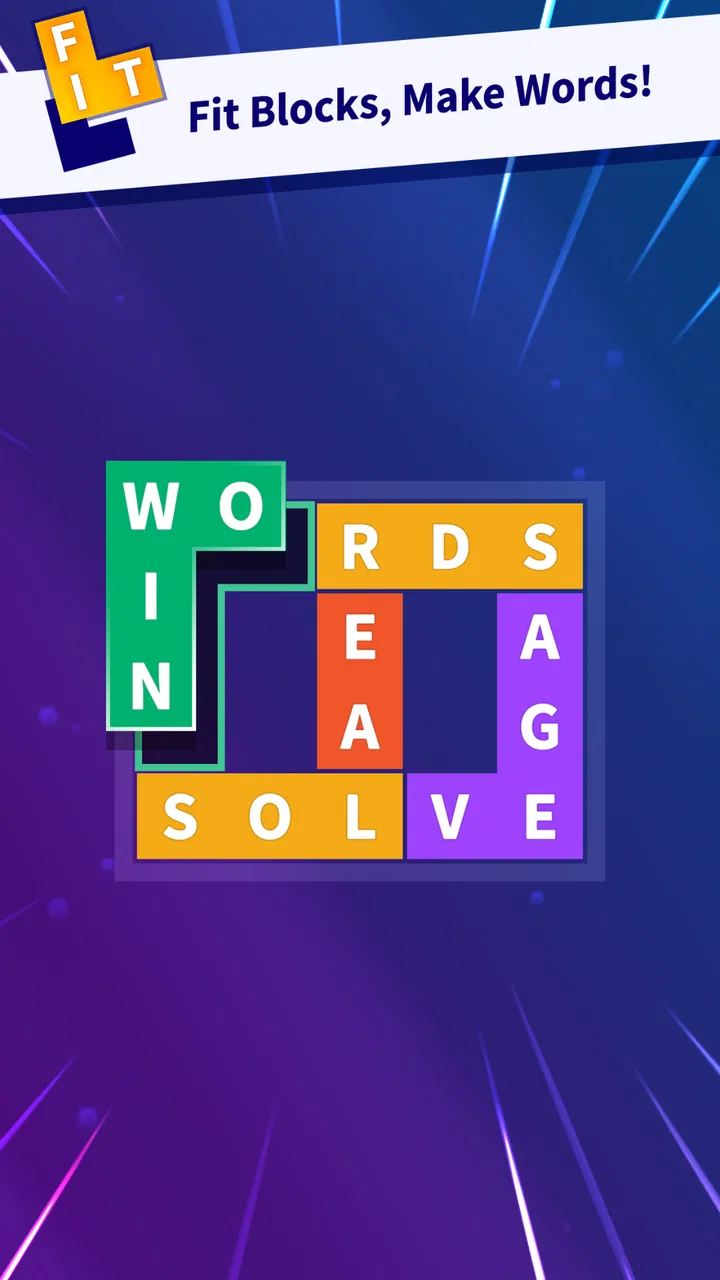
Flow Fit is the kind of word puzzle I reach for when I want something thoughtful without committing to a long session. Its central idea is simple: arrange blocks so they form words, combining the spatial decisions of a jigsaw with the vocabulary pressure of a crossword. That mixture gives it a distinct rhythm. I am not only searching for a word, and I am not only fitting shapes into empty spaces; I am constantly checking whether the letters and the board can agree.
After spending time with it, my main impression is that the game succeeds because it makes ordinary word knowledge feel physical. A familiar word can still be difficult if its letters need to occupy awkward positions, while a less obvious answer may become clear once the available blocks point me in the right direction. It is a free word game from Big Duck Games LLC, rated for Everyone, and it works best as a relaxed brain exercise rather than a competitive vocabulary test.
How the word-and-block combination feels in play
The appeal becomes clear within the first few puzzles. Instead of presenting a blank clue list and asking me to type answers, the game turns the board itself into part of the clue. I look at the shapes, consider the letters attached to them, and try to imagine which arrangement could produce a sensible word. That extra layer makes each move feel more deliberate than entering a guess into a conventional crossword.
You May Also Like

 Blood Strike: 2.5 Anniversary
Blood Strike’s Loadouts Turn Every Drop Into a Tactical Gamble
A close look at Blood Strike’s custom loadouts: how fast access to signature weapons reshapes its battle royale rhythm, rewards preparation, and narrows the gap between fights.

 Pandora - Music & Podcasts
Pandora’s Music Is Easy to Start, but Harder to Recover
Pandora’s strength is its low-effort path from a seed to a station. Its weak spot is how much confidence it asks you to place in connection, setup, and quiet recovery.

 8 Ball Pool
 Is Built on Rivalries, Rematches, and Routine
A close look at the rivalries, rematches, shared routines, and unanswered safety questions that turn a quick pool match into a persistent mobile community.

 Samsung Music
’s Quiet Strength Is Playing What You Already Own
Its reach comes less from spectacle than from dependable access to a personal library. That simplicity is both the app’s strongest retention engine and its ceiling.

 AccuWeather: Weather Radar
AccuWeather Review: A Quick, Clear Forecast for Everyday Decisions
For everyday plans, the best forecast is the one you can understand quickly. AccuWeather makes rain timing, radar, and local conditions easy to act on, with a few trade-offs.

 Hill Climb Racing
Why Hill Climb Racing Still Turns Crashes Into One More Run
A tiny car, a bumpy hill and one more upgrade: Hill Climb Racing keeps resurfacing because its simple chaos makes every near-miss feel personal.
More From Our News Desk
View All News


The strongest part of the design is the constant exchange between language and space. A word may seem promising when I read its letters in isolation, but it can fail because the corresponding pieces do not fit the available layout. Conversely, a particular block arrangement can suggest a word I would not have considered from a clue alone. This makes the solving process feel like deduction rather than simple recall.
I also like that the concept is easy to explain to another person. If a friend asked what I was playing, I could describe it in one sentence: fit the letter blocks together to make words. That accessibility matters because the game does not require prior knowledge of a complicated rule set. The challenge comes from solving, not from learning a dense interface.
The presentation supports short, focused sessions. I can pick it up while waiting for an appointment, play through a puzzle, and put it down without feeling that I have abandoned a larger campaign. That makes it more practical than word games that depend on a daily streak, a live opponent, or a long chain of connected objectives. It is a quiet activity, suited to moments when I want my attention occupied but not overwhelmed.
There is also a useful difference between being stuck and being completely lost. Even when I do not immediately see the answer, the blocks give me something concrete to manipulate mentally. I can test one arrangement, reject it, and use the result to narrow the possibilities. The board creates a trail of reasoning, which is more satisfying than repeatedly typing random words.
Why the puzzle format rewards patience
The game is at its best when I resist the urge to force the first plausible word. A common mistake is to recognize a few letters and immediately build around them. That can leave an awkward piece stranded or create a sequence that looks almost correct but cannot be completed. I get better results by first examining the largest or most restrictive shapes, then considering which word patterns could accommodate them.
This is one of the less obvious strengths of the format: the physical arrangement encourages a useful solving order. In a standard crossword, I often jump between clues according to confidence. Here, I pay more attention to constraints. A block with limited placement possibilities can tell me more than a letter I already recognize. Starting with the most restrictive element reduces wasted guesses and makes the puzzle feel less random.
Another practical habit is to separate certainty from possibility. I may be convinced that a partial sequence resembles a familiar word, but I try not to treat that idea as final until the surrounding pieces support it. This prevents one attractive guess from controlling the entire board. The approach is especially helpful for players who tend to overcommit early in word puzzles.
I also find that the game can exercise a different kind of vocabulary awareness than a traditional crossword. Crosswords often reward knowledge of definitions, abbreviations, or cultural references. Flow Fit puts more weight on recognizing patterns while managing space. Someone who is not a crossword expert may enjoy that because the task feels less like answering trivia and more like assembling a compact language-based puzzle.
Where it fits among familiar word games
Compared with a classic crossword, this game is more visual and less dependent on clue interpretation. That makes it a better choice for me when I want wordplay without reading a page of hints. The trade-off is that players who love clever clues, themed answers, or broad general knowledge may find the experience less expressive. The satisfaction comes from fitting and confirming, not from decoding a witty question.
Compared with a word-search game, it asks for more planning. A word search usually lets me scan for a known answer and trace it through a grid. Here, I need to reason about how pieces interact before the solution is complete. That gives Flow Fit more depth, although it can also feel slower when I am tired or when I want a very quick visual distraction.
It is also different from an anagram game. Rearranging letters is only part of the task; the blocks impose a spatial condition that can invalidate an otherwise correct sequence. I appreciate that extra restriction because it stops the game from becoming a pure speed exercise. However, anyone who mainly enjoys making as many words as possible from a letter set may prefer an anagram-focused alternative.
The closest comparison is probably a hybrid puzzle, but the hybrid works because neither side completely dominates. The word element prevents the board from becoming a generic shape-fitting exercise, while the blocks stop it from being just another vocabulary quiz. That balance is the reason I would recommend it to people who have tried both word and jigsaw-style games but want something between them.
The friction that affects the experience
The same simplicity that makes the game approachable can limit its appeal over time. If I am looking for a deep progression system, a story, social competition, or a large collection of distinct modes, this is not where I would start. Its pleasure comes from the individual puzzle structure, so players who need constant novelty outside the core mechanic may eventually want something broader.
The format can also become frustrating when I see a likely word but cannot make the pieces cooperate. That tension is part of the intended challenge, yet it does not always feel equally fair from one moment to the next. A player who prefers immediate feedback may dislike spending time circling around a possibility with no obvious route forward. I would approach it with patience rather than expecting a fast chain of easy successes.
Another limitation is that the game does not naturally serve every kind of word-game player. If my goal is to expand vocabulary through definitions and explanations, a dictionary-based crossword or learning app would be more useful. Flow Fit encourages recognition and arrangement, but that is not the same as teaching why a word means what it means. It is a puzzle first, not a structured language course.
The free price makes trying it easy, though in-app purchases ranging from ninety-nine cents to two dollars and ninety-nine cents per item are part of the experience. I would keep that in mind before treating the game as a completely cost-free long-term hobby. The sensible approach is to enjoy the basic access first and decide later whether any optional spending improves the way I play. I would not buy anything simply because I was stuck on one puzzle.
Device compatibility is reasonably broad for an older Android handset, since the game requires Android 6.0 or later. The current version is 1.2.3, so I would check that my phone meets the system requirement before planning to install it. That detail matters most for people using an older device, while newer Android users are unlikely to find the requirement burdensome.
Everyday situations where it works best
My favorite use case is a short waiting period with no desire to open a social feed. A puzzle gives me a contained task: I can study the blocks, make a few attempts, and stop when my name is called. Because the game does not require another person to be available, it works better than a multiplayer word game when I want control over the length and intensity of the session.
It is also suitable for a quiet evening when I want something more active than watching a screen passively. I can play at a comfortable pace and let the spatial side of the puzzle keep my attention anchored. The game is not so demanding that it requires a completely silent room, but it is engaging enough to discourage mindless tapping.
For families, the Everyone age rating makes it approachable as a shared puzzle idea, although I would still expect different players to enjoy different parts of it. A child may focus on fitting the shapes, while an adult may contribute possible words. That does not turn it into a formal cooperative game, but it can make a single puzzle an easy conversation starter without requiring specialized knowledge.
I would not choose it for a party or a competitive group session. The design is better suited to individual concentration than to rapid turn-taking. Likewise, it is not my first choice when I have only a few seconds to spare, because the satisfying part is considering the relationship between several blocks rather than making one instant guess.
Who should install it, and who should pass
I think it is a strong fit for players who enjoy crosswords but want more visual interaction, and for puzzle fans who like arranging shapes but still want language to matter. It is especially appealing if I prefer calm, self-paced games with rules that can be understood immediately. The combination gives familiar wordplay a tactile feeling without turning the experience into a complicated strategy title.
It also suits people who become bored with word games based entirely on speed. Flow Fit gives me a reason to slow down, inspect the available pieces, and revise a plan. That makes it a good companion for a commute, a break, or a low-pressure evening session, provided I am comfortable with occasional uncertainty while searching for the right arrangement.
I would suggest skipping it if I want detailed vocabulary instruction, competitive leaderboards, rich narrative content, or a wide range of unrelated activities in one application. A conventional crossword is better for clue solving, a word-search game is better for quick scanning, and an anagram game is better for rapid word production. Choosing one of those alternatives would not mean Flow Fit is weak; it would simply mean the central block-fitting idea is not the kind of challenge I want.
The game has attracted an average rating of 4.5 from around 3.5 thousand ratings, with over 900 written reviews and more than 100 thousand installs. Those figures suggest that its straightforward concept has found a real audience, but I would still judge it by the type of puzzle I enjoy rather than by popularity alone. A high rating cannot remove the basic trade-off: the focused mechanic is the appeal, and also the boundary.
My final recommendation
Flow Fit is a thoughtful little word game with a clear identity. Its best quality is the way it turns vocabulary into a spatial problem, making me consider not just which word might work but whether the pieces can physically support that answer. That is enough to separate it from ordinary crosswords, anagrams, and word searches without burying the player under complicated systems.
I would recommend installing it if I wanted a free, Everyone-rated puzzle for short or medium sessions and enjoyed solving through trial, arrangement, and pattern recognition. I would approach the optional purchases carefully, especially if a difficult puzzle tempts me to spend just to move forward. The game is more rewarding when I treat being stuck as part of the reasoning process.
My final verdict is positive but specific: this is a focused hybrid for patient word-puzzle players, not an all-purpose brain-training package. Big Duck Games LLC has built its appeal around one central interaction, and that interaction is genuinely enjoyable when I want a quiet challenge. If that combination of letters and shapes sounds more inviting than a standard clue grid, it is worth trying; if I need variety, competition, or language lessons, another category will serve me better.
FAQs for Flow Fit - Word Puzzle
01What is Flow Fit - Word Puzzle, and how is it played?
Flow Fit - Word Puzzle is a relaxing word-placement game that combines crossword-style thinking with a visual grid. Instead of typing answers, you arrange word pieces or tiles so they fit correctly into the available spaces. Each level asks you to recognize patterns, test possible combinations, and complete the board. The early puzzles are approachable, while later stages require more planning and patience.
02Is Flow Fit - Word Puzzle suitable for beginners and casual players?
Yes. Flow Fit - Word Puzzle is designed to be easy to understand, even if you do not regularly play word games. The basic mechanics can be learned quickly, and the gradual increase in difficulty gives beginners time to become comfortable with the board and tile arrangement. It is also a good choice for casual sessions because most puzzles can be played at your own pace without demanding fast reactions.
03Does Flow Fit - Word Puzzle require an internet connection?
The core puzzle experience is generally suitable for playing offline, which makes the game convenient for travel, commuting, or areas with an unreliable connection. However, some features may depend on internet access, including advertisements, optional rewards, updates, analytics, or promotional content. If you want to play without interruptions, it is worth testing the game in airplane mode after installation, since online requirements can change between versions.
04Is Flow Fit - Word Puzzle free to download, and does it contain ads or purchases?
Flow Fit - Word Puzzle can typically be downloaded for free, but the free version may be supported by advertising and may offer optional in-app purchases. Ads can appear between puzzles or when you request extra assistance, while purchases may provide an ad-free experience, hints, or other bonuses. Before downloading, check the current Google Play or App Store listing for the latest pricing and purchase details.
05Does Flow Fit - Word Puzzle include hints, and what happens when a puzzle becomes difficult?
When a level becomes challenging, the game may provide hint-related options or other assistance, depending on the version installed. These tools can help reveal a possible move or reduce the number of choices, but they may require earned resources, watching an advertisement, or making an optional purchase. Players who prefer a pure challenge can usually attempt the puzzle repeatedly without using help, making the game suitable for both relaxed and more demanding play.
Pros
- Simple rules make it easy to start playing immediately.
- Short levels are ideal for quick breaks or casual sessions.
- Minimalist visuals keep the board clear and easy to read.
- Gradually harder puzzles provide a satisfying learning curve.
- Works well for players who enjoy calm
- logic-based challenges.
Cons
- Later puzzles can feel repetitive if you play for long sessions.
- Some solutions may require trial and error rather than pure deduction.
- Limited variety may reduce its appeal for players seeking more game modes.
- Progress can feel slow when puzzles become significantly more difficult.
- Ads may interrupt the experience
- depending on the version and settings.

Flow Fit - Word Puzzle
Gallery